Pages

Friday, October 1, 2010

Pray for us sinners now and at the hour of death.


I'm not sure how or why I got onto Barnes and Noble's e-mailing list. I haven't bothered to get myself off of it because sometimes they send me good coupons, but I happen to live in a city with lots of library options, so I very rarely buy books, especially ones I haven't read, which I realize might sound weird and might take all the fun out of reading for people, but for so many years of my life, I had books taking up space on a countless number of shelves, books I never read or intended to read, books I attempted to read and hated, so I've decided that I will not spend any money on a book that I'm not sure I will love (holy run-on sentence, Batman). Therefore, most of the time, I get a book out of the library, take it for a test spin, and then, if it tugs at my heartstrings and makes me catch my breath, I go out and spend the money on it so that it may rest peacefully on my bookshelf not wasting space but serving a purpose. Although, chances are, it may sit there the entirety of my life never having its binding broken open, because I rarely read books twice.

At any rate, shortly after I spent that long weekend at home with my mother while my husband was on a father-son trip, I got an email from Barnes and Noble that caught my eye. My mom and I had just seen "Eat Pray Love" in the theater, which I loved (but mostly for the part where they're describing how Italians talk with their hands because it was SO TRUE), and the subject of the email was "Powerful and Uplifting: A Mother-Daughter 'Eat Pray Love'." So quite unlike myself but driven by curiosity due to current events, I actually opened the B&N email to find a book recommendation for "Traveling with Pomegranates" by Sue Monk Kidd, who some of you may know through her unmistakable novel-turned-movie "The Secret Life of Bees." I am unfamiliar with that work, only know of it by the trailers I've seen during commercial breaks on television, so the fact that she had penned that particular piece was really of no interest to me. What caught my attention, however, was that not only was it a memoir, but it was a shared memoir, alternating essays written by herself with essays written by her daughter.

Naturally, I looked it up on my city's library catalog to see if this was something I could borrow first to see if it was even worth my time. And I found it currently in stock sitting on the shelf waiting for me. And then my husband came home from work and asked if I wanted to go to the library to look for instructional books on how to lay hardwood floors, which he plans on doing in our new house. It was like it was meant to be.

And it was meant to be. The book, while I still have a third of it yet to read, has been such a delight and I plan on buying myself a copy, as well as a copy for my mother and mother-in-law, because I feel it is just too good not to share. I mean, it takes place in Greece and France, had oodles of Greek mythology in it, and I feel it has a rather accurate representation of my current relationship with my mother and is relevant to the periods we are both in in our lives.

But what I seem to like most is the constant presence of the Virgin Mary and what Mary means to these women and all women in general.

I've never been very religious. I've tried to be religious many times in my life, and sometimes I've tried harder than others. I still want to be religious, but haven't quite come to terms with how to do that yet. But I've always felt a connection to Mary. I've always found her to be the most interesting character in all of Christianity, and yet I feel like she is constantly overlooked. Which is perhaps why I like her even more. It's like her and I have a little secret that no one has quite caught onto yet.

I know it all started when my grandma died. I was only five at the time. But ever since then, I've always associated my grandma with Mary. I guess I thought they would get along very well in heaven. Everyone always said my grandmother was a saint. So I guess this was my way of making her one. Besides, I was five. What I knew about death and heaven was so very limited (not that I've learned all that much about it since then). I knew who Mary and Joseph and Jesus were, I knew they were in heaven, and now I knew my grandmother was in heaven. So I suppose it was only natural that I put them all in the same clique up there.

Of course, too, there was the song that they played at her funeral. I don't remember anything about the funeral. I don't remember anything about her sickness or her death. I sometimes think I do remember, but I'm pretty sure it's just the stories that people have told me that I remember and not the actual events themselves. But there is this song that is very common in Catholic churches, especially in the spring, called "Hail Mary, Gentle Woman" that was played at my grandmother's funeral. It's a terribly sad, but beautiful song. My brother hates it... he says the harmony is annoying. I think he either hates it because he's not a woman and doesn't have a connection to Mary or he hates it because he remembers it being played at the funeral (him being 9 at the time and fully capable of remembering) and it makes him sad. And while I myself don't remember it being played at the funeral, what I remember is that every time it is played in a Catholic church to this day, my mother (and aunts, if they are there, too) break down into sobs. And now that I'm old enough to be the kind of sentimental where I cry at happy endings of movies and sappy songs on the radio, I am usually sobbing in the church pew right along with them.

Still, it wasn't until I spent some time in Italy that my infatuation with Mary was brought more to the forefront. As Catholicism is the official religion of the country, Mary is everywhere. She's in the churches, in the museums, but even just on the street corners and painted on apartment walls. I would say the point in my life where I respected religion the most was when I was living in Italy. And perhaps it was when I was the most spiritual.

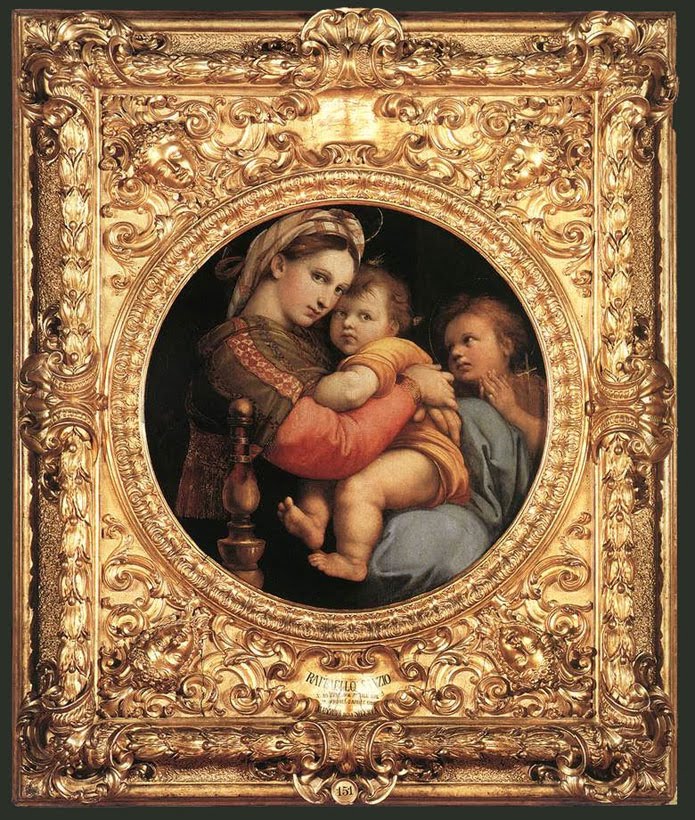
Because I was "studying" in Italy (technically, I had already graduated, so the classes I didn't care about so much as the whole being in Italy thing), our group went to every single museum in Florence and saw COUNTLESS paintings of the Virgin to the point where they all started to look the same and frankly were starting to get a little boring. But when we got into the Uffizi, I saw a new portrait of Mary that I couldn't take my eyes off of. It was called "Madonna of the Chair." I've posted it at the top of the entry, but I'm not too techy with this whole blog thing yet, so I couldn't get it to go where I wanted it to go. But you can click on it and make it bigger.

ANYWAY, I just thought Mary looked so HUMAN in it. So many other paintings she's depicted as a saint or as royalty, which she is and deserves to be depicted that way, but she was also human, and I think it's the human aspect of her that makes her so appealing. I mean, the woman gave birth in a field, people, with a man she wasn't even married to. I'm married, and my husband is capable of a lot of things, but I don't think I'd let him birth my baby in the middle of g.d. field. And she raised the SON OF GOD. Like, she had to put him in time-outs when he acted up and had to protect him and take care of him. And she had God to answer to if she didn't do her mothering job right. But this painting, it doesn't feel like a painting of Mary and Jesus. It feels like a painting of a mother with her son. She's got a loving, protective grip on him. She seems to know she's gonna have to let go of him, but you can tell she doesn't want to. And all the while, she seems to be giving a look to those watching her that says, "You mess with my baby, you mess with me."

Later in the trip, our leader/instructor took us to an artisan shop to show us that things are still handmade in Italy and that generations of families stay in the same business, and I found that exact picture buried in a pile of plaques, outlined in beautiful gold paint, handcrafted in that very shop. Now I don't know how popular this image is in Italy. But the Uffizi is just ONE museum in Florence and it alone has thousands of paintings in it. What are the chances I would that painting in an artisan shop down some isolated alley? Like it was meant to be.

My mother took a tour group over to Italy the year after I had lived there. I couldn't afford to go with her, which broke my heart. She asked if she could bring anything back for me. I said the only thing I wanted (besides nutella gelato) was a necklace with Mary on it. And in an artisan shop that sounded much like the one I found my Madonna of the Chair in, she found the perfect, most absolutely beautiful Mary cameo and she bought it for me. I still wear it all the time over three years later.

I wear it as a reminder of what I want to be. I don't want to be the next Mother of Christ. I can't be the next virgin mother. That ship has sailed. But Mary, despite being saint royalty, was once a very human woman, a hard-working woman, a proud woman, a woman who did what she had to do without complaint. And from what I've heard about my grandmother, she was a lot like that, too. If I can be half the woman my grandmother was, I would consider my life a success.

Gentle mother, peaceful dove, teach us wisdom, teach us love.

Sometimes I worry that this book is going to be an epic failure, that no one is going to want to read 200 pages about death and grieving, that no one will care about my life or my grandfather's life. But "Traveling with Pomegranates" isn't all happy-happy. In fact, it's mostly not. And yet I can't seem to put it down. After all, death and grieving is a big part of what makes us human, no?

Wednesday, September 29, 2010

We are all just prisoners here of our own device...

I don't know how people who work from home do it. I had an afternoon all scheduled for writing and drinking champagne on my deck, but in the allotted hour I gave myself, I ended up hanging clothes up (I hadn't anything to wear that was already in my closet), drying my hair (which seemed to be drying faster than normal, and if I let it air dry, I would look ridiculous and I had plans that evening), cleaning off the patio furniture (because I couldn't write on a table covered in potting soil), moving the laundry from the washer to the dryer (because if I didn't do it right then and there, I would certainly forget it altogether), and cleaning off the champagne glasses (because we usually never drink champagne, so they had a good year's worth of dust on them) that by the time I was sitting down to write, I had a mere 20 minutes left, and then I went ahead and wasted five more minutes whining about it here.

And yet here I am with whatever little time I have left because it's about damn time I start sticking to my guns and actually do things I say I'm going to, which I've never been too good at doing in the past. Thus, the reason I've been absent so long. There hasn't been anything worth writing about--well, of course there is always SOMETHING to write about, but as far as the status of my writing or new things I've been learning, new leaps I've taken, there simply haven't been any.

Failure, of course, is something worth writing about and something I'm getting to be an expert at for certain. However, I'm not particularly fond of writing about my failures, mostly because my failures tend to be self-inflicted. I'm perfectly aware that if I don't write, it's simply because I haven't taken the time. There is no one to blame but myself. As the Eagles might say, I'm a prisoner of my own device, stuck in a continual Hotel California not even trying to find a way out. I can't complain about my life not going the way I want because I am capable of changing it. What a powerful statement. I am capable of changing my life. I am capable. I choose not to.

And to write about my failures would feel like I was only complaining when I have no right in which to complain. Thus, I have remained quiet, not facing my life or my failures, watching time tick by, nearly three months into the project and still the same ten pages to show for it.

If it's one good thing I can say about the past month, it's that I've forced myself to go back to hip-hop dance class. At least I'm doing some extra-circular activity that gets me out of the house and gets me thinking about what I really want out of life. Believe it or not, dance classes are a great place to think, or at least they are for me. It seems like I would be too distracted with counting and memorizing move sequences and trying not to look like the white girl ironing board that I am compared to my smooth, sexy instructor who probably came out of the womb popping and locking.

But in a dance studio, I spend my entire time staring into a mirror, realizing all the flaws and imperfections, every move that is correct and every move that is incorrect, my facial expressions when I miss a move, when I get a move right, the way I feel the music and the movements. It's no internet blog that I can hide from and avoid for a whole month. Everything is laid out in front of me; all the problems that I have to fix are unrelentingly reflected back at me. And most of the time, I'm scared shitless that my classmates or Mr. Smooth Sexy Instructor are watching me, judging every one of my mistakes, but then I realize it's just me and the mirror. Everyone is focusing on themselves, finding the errors within themselves and attempting to repair them each time the music restarts.

I suppose that's what makes it hard about trying to make friends in a dance class. Sure, there are times where we're all joking about a move or helping each other out with some sequence, but for the majority of the class, we are each in our little bubble, alone with the music and the mirror. I've been meaning to stay a little later after class, try to talk Mr. Smooth Sexy Instructor about any other dance opportunity he may know of for 20-something ex-baton-twirlers or find out how the other girls in the class spend their free time. But I guess I find it exposing enough that these people see me struggle with moves and constantly misstep. I guess by the end of class, I'm just ready to get back to my safe cocoon that is my car and my normal boring life.

Which is a shame, really. I have found in the past that the bond shared between people with the same passion is the strongest bond of them all. I often think fondly of a specific moment in my past, standing around a piano late at night at Adrian College when most people are back in their rooms, surrounded by strangers who quickly became family at a summer camp, my dear friend playing a song from Les Mis his fingers have memorized and all of us singing along casually, poking at each other and laughing all the while. It's a kind of camaraderie you only understand if you've had it before. And even just standing around a piano singing warm-ups or a song everyone knows, what fun we all had. It was all we wanted or needed in that moment. It may sound silly, but I miss standing around a piano with people like me.

Sometimes I think all of this would be easier if I had chosen to hang around people who had the same life goals and passions as I do.

It all goes back to what John said that first night I attended Writing Club. He said writing is a lonely business. And it is. I keep fooling myself into believing that I can write and NOT be lonely, that I can spend time with my husband, our families, our friends, and STILL write. But that's not the case, not all the time anyhow. To achieve my dreams, I need to instill discipline in my life and I have to be willing to sacrifice, even if sacrifice means being alone, even if only for a temporary time. And I guess I haven't been willing to sacrifice yet. It's funny, really. Writing is what I really want to do, but I'm not willing to sacrifice what's necessary to get it. I suppose that's something I'll have to come to terms with.

A funny ending to a rather pensive entry: My husband came home and gave me a kiss hello, quickly followed by a, "Have you been drinking?!"

"Just a glass of champagne," I batted my eyes innocently.
"It's not even 5pm!"
"It was just one glass!"
"Yeah, right."
And then giggles ensued, which did not help plead my case in the least.

Wednesday, September 8, 2010

Taking ownership...


Chris and I didn't even bother getting out of bed on Monday until nearly noon. After all the running around we did on the weekend, we were determined to have a lazy Labor Day. But eventually we got out of bed, cleaned up, and went for a drive. Chris was out of gas from our trip around the state, visiting both families and both sides of Michigan, so we stopped at the corner gas station. It was raining, so I waited in the car while Chris filled the tank. I was staring off at the traffic on 28th street when Chris tapped on driver's side window and mouthed some words to me about a book. "Huh?" I scrunched my eyebrows to get the point across. He reached back and then held up a book for me to see, a sorry-looking left-behind token, wrinkled and wet from the dripping rain. He laughed and turned to put it back where he found it. I tapped on the glass and waved my hand towards me. He opened up the door and said, "You want it?"

"I want to look at it," I said. It was called "Stealing Buddha's Dinner," which interested me right away because I had been thinking about Buddhism a lot and about how important balance is and how I might incorporate more of it into my life. When I flipped it around to look at the synopsis on the back cover, I realized it was a memoir. At the very least, I could use it as another example of what a successful published memoir looks like and try to mirror it in my work. And then I opened up to the first page and read, "We arrived in Grand Rapids with five dollars and a knapsack of clothes." And I had to have it.

Now, I don't condone stealing, but it was obviously abandoned. And besides, for all I know, it very well could have been a gift from Fate, an opportunity for change in my life. Although I haven't put much stock into Fate since I was a freshman in college, I have been trying to be better about exploring such opportunities that present themselves in my daily life. For example, I took that hip-hop dance class in the spring BY MYSELF without knowing anyone else. That was big for me. I learned how to knit at a knitting club that was offered at our apartment complex (and learned I'm not too great at it). And I joined a Writing Club, which is even more risky because I put myself out there to be judged by total strangers. I recently met with a man who is starting his own business and needed a "creative writer" to help him with some of his projects, and I've also interviewed for a ballroom dancing instructor position. My reasons for doing such things? Because I thought they sounded interesting. Because I don't want to sit on the couch every evening. Because I want more adventure in my life. Because I didn't have a good reason not to.

My long-lost summer camp friend and fellow blogger (though she is much more advanced at it and much more popular than I am) Rachel Wilkerson has been inspiring so many people on the web, including me, with her world-renowned concept of OWNING IT. She says people need to stop feeling guilty and instead of saying "I'm sorry," say, "Sorry, I'm NOT sorry." If you're one the few on the net who aren't down with her message yet, see it for yourself here.

So I'm owning the fact I stole an abandoned book at a gas station. And I'm sorry I'm not sorry.
And I'm owning the fact that I refuse to settle for a life that doesn't have adventure and passion.
I'm owning that I like Usher's "Love in This Club" and dance around to it in the bedroom.
I'm owning that I eat junk food and watch old "Grey's Anatomy" DVDs after work before my husband gets home.
I'm not sorry for any of it.

As hypocritical as this may seem, I didn't end up taking the "creative writing" position or the ballroom dance instructor position. At first I did feel guilty about it. I felt like I wasn't doing more to change my lifestyle and to get out of my dead-end job. I felt like maybe I was throwing opportunities away. But then I owned up to what it is I really want out of life. No matter how long I've been out of school, no matter how many stupid jobs I've had, there's always been one thing I wanted, but I've been too scared to go for it. And I've been hiding behind lots of lame excuses so I could avoid putting myself out there to achieve it. And the creating writing job and the dance instructor job, while I'm sure I would enjoy them and perhaps even be successful at them, AREN'T WHAT I REALLY WANT, and it's time to stop settling and get what I want most out of life.

I'm owning that I want to go back to school. I'm owning that I want to get a better degree. I'm owning that I want to write. And I'm not sorry.

So, hopefully, Rachel, this is part of "getting it." In her words...

Don’t ever settle. Everything you’ve ever wanted is within reach. Everything. Seriously…everything. So get it.

I still have a long way to go. There are still plenty of things I'm still sorry for and feel guilty about. And every day, I feel like I have to "get" things all over again or remind myself not to settle. But I suppose that's just life.

In other news, when I saw my mother this weekend, she had a box for me. As I removed the newspaper wrapping, I had to laugh. In it was the tree mug and retro '60s mugs from my grandfather's kitchen, the ones that I spent most of my time haunting a few weekends ago. Maybe grandpa's mug will give me more inspiration for my book. Perhaps I'll make a cup of tea in it later and see what kind of memories steep onto the page. Then again, Grandpa never drank much tea.

Thursday, August 26, 2010

Going home again.

I got on my writers' group's web site last night to RSVP for the next meeting and quickly realized that I had missed this week's gathering. It hadn't even occurred to me that two weeks had gone by already. It definitely didn't feel like a fortnight, that's for sure. I guess it didn't matter all too much. I hadn't done any new writing, only had gone back and tried to work on all the critiques of last meeting, which did end up adding on two more pages to the "novel." So now I have six pages. My grandfather has been dead nearly a whole two months and I have six pages to show for it and only 10 months to go.

I suppose it's only natural that I've been a little flaky the past two weeks with the whole house hunting process. We did find a house already and have had our offer accepted, which is super speedy from what I've heard when it comes to buying a house. In a way, I'm glad that it only took two weeks, because it's such a demanding and chaotic process. So while the idea of paying both a mortgage and a rent payment for two months because we can't break our lease scares the bejeebus out of me, at least I have little excuse not to write now.

And you would think I would be full of words after last weekend, but that doesn't seem to be the case. Chris left town with his father for some male bonding time and I stayed at my Mom's, talking about Grandpa, going to Grandpa's house, visiting his grave. My senior year of high school, I lived with my grandfather for five months and I know I thought it was terrible at the time, but I can't remember why. So I even dug out the journal I kept senior year and stayed up late at night reading it in hopes of figuring some of that out. Unfortunately, I was involved in a very ridiculous drama-filled high school romance at the time and the majority of the journal was riddled with "love is grand" or "boys suck," with a few "I hate living in Grandpa's house" thrown in there, and that was about it. So no help from that.

I'm not really sure I got the closure I was looking for being in Grandpa's house. I think it made the wound more open, to be honest. I was hoping that I would get to explore the house on my own, to have some quiet time with my memories, but my godparents were there when we showed up, so no luck. I'm not sure it would have made a difference. I'm not even sure what I was really looking for. I felt like I was the ghost in the house, not Grandpa, haunting every room, lingering for no reason in places, trying to take it all in before having to give it all up. I spent most of my time hovering near the coffee cup tree, touching a coffee cup that Grandpa didn't even use, but I felt that coffee cup alone summed up all my memories of that house. I traced the black lines on the dirty-colored porcelain with my fingers, outlining the design of vibrant oranges and their leaves, thinking about how my father used to drink his morning coffee on Sundays from those mugs, how Aunt Beth would take the pot to the living room, first filling up Uncle Jim's mug and then Grandpa's even though no one asked her to. Mom asked me more than once if I wanted to take the mug home or if I wanted the entire mug tree, but I kept saying no. What would I do with a mug tree? What would I do with these hideous '60s mugs? Part of me wanted to take everything home, and part of me wanted everything to stay exactly as it was.

The house wasn't anything like it should have been. So many things have been cleared out and what was still left was stacked against walls on top of each other, often in boxes. It didn't really matter. It was still Grandpa's house to me. I could still see it how it should have been. My cousins are moving into it, changing things around and painting, but I think no matter how they decorate or renovate, I'll still be able to walk into that house and see things just as they always were, rewind the clock and see everything in its proper place, my grandfather rocking happily in his plush mauve lazyboy in the living room.

Thursday, August 12, 2010

Que sais-je?

I was attempting to hold a book hostage from the library this week. Apparently, you can only renew books once, which I had already done, and so it was demanding to have its book back. I called the library and said, "Hell, no, I'm keeping the book and you have to pay me a quarter for every day I don't return it." Oh, wait. They charged me a quarter for every day I didn't return it. I guess that whole hostage situation didn't turn out too great for me. So eventually I gave in and returned it, and with the money I owed the library, I went to Barnes and Noble and bought my own copy.

It's a really insightful how-to-write book by Bill Roorbach called "Writing Life Stories." If you're trying to write a memoir or an essay or what have you, I think it's an excellent source. Even if you already know all the tips he gives you (which I definitely didn't), it's still overflowing with inspiration, and one can never have too much of that.

One particular such inspiring passage talked about this writer from the 1500s named Michel de Montaigne, whom I had never heard of before. Apparently this writer wore a gold medallion around his neck that had the inscription "Que sais-je," which is French for "What do I know?" It's a rather interesting question for writers, definitely, but for anyone really. I liked it so much, that in true Jenny fashion, my first instinct was to get it tattooed somewhere. But my husband would talk me out of that in the end anyhow, as he tends to do every time I want to tattoo something new on myself, which happens more often than you might think.

So what do I know? Generally, I feel like I don't know much. I don't know much about mortgages (but I'm learning with our ongoing house hunt). I don't know much about politics (except what my husband's opinions are). I don't know much about anything, really, or so it seems. But sometimes I think not knowing is what makes a writer great. It can give a connection to the reader and the writer and let them figure out things they don't know together.

However, Roorbach insists that people know a lot more than they think they do. He said Montaigne "was an expert on himself (as we all are, or should be) and so reported confidently, as an authority... Look inside yourself. What do you know? The answer is that you know a lot, about myriad subjects."

It makes perfect sense. If it's anything we should all be experts on, it's ourselves. Which works out for me, trying to write a memoir and all. But isn't it such hard concept to keep in mind from day to day? I know I often feel like I don't know more than I do know, but I think most people feel that way.

Where the book is involved, though, I definitely know a lot about myself and my relationship with my family and my family, in general. Which I'm sure will come in handy. What the writing group pointed out to me this week, though, is that I don't do a very good job of sharing that knowledge with the rest of the world. Turns out that since my family's habits and personalities are so second-nature to me, I don't explain them for the rest of the world to understand. For example, I wrote about how my Aunt Louise smiles and people thought it was weird she was smiling at a funeral. But Aunt Louise is always smiling, no matter the circumstances. I don't think I've ever not seen her smile. Any other person wouldn't know that, though. They would just think she was being insensitive in such a serious atmosphere. So that's something I have to go back and work on.

Also, I'm having another problem with tone in my story. I don't want it to be all ho-hum because it is taking place at a funeral, but I think I've overcompensated and made the mood too light. Some people thought it was clever that I was making light of such a gloomy situation, but other people thought it made me an unreliable narrator. Which is a funny concept, being an unreliable narrator in a story about you written by you.

And then there's also the problem with dialogue. Someone suggested I have more of it. I've never been good with dialogue. I feel it's boring. But I guess I had better give it a whirl anyhow.

So many times, especially this week when our schedule has been so unpredictable and choatic, I feel like I don't know anything about writing. And then I go to writing club and I feel like maybe I know a little about writing, but definitely not much. I never feel discouraged, though, which is a good thing, I guess. I asked the group flat-out if they thought my piece was boring, and they all said encouraging things without really answering the question. I didn't know if that was a good thing or a bad thing. Then I got home and I was reading through my comments, and one person wrote down, "I didn't think it was boring." So thank you, fellow writer, whoever you are (I couldn't tell by the handwriting). It's nice to know I'm not boring.

So off the top of my head, here's what I know right now:
1. John, the amazing writer who rhymes at Writing Club has bluer eyes than I do, like freaky ridiculously blue eyes. So even though his face looks tired, his eyes are always awake.
2. House hunting absolutely consumes your entire life to the point where it gets obsessive, always checking online to see if a new house has popped up or if perhaps you overlooked one.
3. I cannot have the TV on and expect to get anything productive done, unless I'm in the kitchen, but then I can barely hear the TV anyhow, so it's really not the same thing at all.

Unfortunately, none of those things will help me with my book at all.

Friday, August 6, 2010

Julie, Julia and Jenny.

I have a habit, and I think I probably share it with many women in this world, that, come Sunday night, I make all sorts of resolutions about how I'm going to change my life around. Like Monday is an automatic fresh start, clean slate, even if I ate nothing but burgers and hot dogs and sat on the couch watching "Dirty Jobs" all weekend. All is forgotten come Monday and life starts over.

Well, when I wrote my last entry, I had decided that I was going to write out a whole section of the book this week, at least get a rough draft on the paper. I'm glad I didn't write that into my post, because wouldn't you know it, I didn't do it. In fact, I barely wrote at all this week. And I ate fast food every day and only went to the gym once. I did floss twice this week, which is a new record. Doesn't really seem like that should be pat-on-the-back worthy, though, considering I should floss every day, as my husband lovingly reminds me as he picks through his own teeth.

I did have one goal on Monday that I actually did accomplish this week, and that was finish reading "Julie & Julia" by Julie Powell. See, when I had originally thought about writing this book, I thought it would center around my struggle to recreate some of my grandfather's famous family recipes (I've since abandoned that premise because I've found way too many other things I want to write about, but I will still probably find a way to incorporate that idea into the book). My main connections to my grandfather are his house and his cooking. I'm the one he made the applesauce for, because he knew, come Sunday morning, I would be asking for it. And all of my cousins knew which of Grandpa's cupboards to go to to find freshly baked chocolate chip cookies. So Grandpa's food was always a big part of my life and a big part of my memory.

But to write a book about cooking? I had no idea where to start. So my first order of business was to find a role model of sorts, and what better place to start than the recently world-renowned phenomenon that is "Julie & Julia." Well, I had made the mistake of seeing the movie first, long before I had ever set it in my mind to write a book. And I was in love with the movie. I loved the chronological juxtaposition of the their lives--really everything about the way the story was told. And the Julie Powell in the movie was so likeable. I wanted to be her friend and go to her dinner parties.

Unfortunately, the things I loved about the movie were nonexistent in the book. But then I suppose my expectations were entirely unreasonable. But what expectation I didn't think was unreasonable was that she be able to write well. And in that aspect of the book, I thought she completely failed. I HATED her writing style. I felt like she was constantly breaking all the rules I had been reading about in my how-to-write books. And not just because she was a rebel. Just because she didn't know any better. It gave me a glimmer of hope for my work, though. If SHE can get published, hell, so can I.

She did have some interesting insight into the blogging world, which I will quote from her novel now because it was basically the only passage I liked in the entire book. And pardon the cursing in advance... she has a really dirty mouth.

"Today when we blog about our weight-loss problems and our knitting and our opinion of the president's IQ level, we do it on the blithe assumption that someone gives a shit... Nowadays, anyone with a crap laptop and Internet access can sound their barbaric yawp, whatever it may be. But the surprise is that for every person who's got something to say, it seems there are at least a few people who are interested. Some of them aren't even related."

I give her mad bonus points for using "yawp," mostly because I believe she learned that word, as I did, from the movie "Dead Poet's Society" and not from reading Walt Whitman. And for the record, I have a desktop computer, though now that I am getting friendly with my kitchen table, I'd settle for a crap laptop instead. And half of my comments thus far have been from relatives, but that means half are not. Then again, there's only been 4 comments total so that's not saying much.

As torturous as I felt this book was to read, I figured I had to finish it anyway because if I was going to talk badly about it for the whole world to see, I should at least have read it cover to cover. And truth be told, I'm glad I did, because the last five pages hold more insight than the 302 that precede them. And while she was writing about Julia Child's death, it felt as if she was writing my novel for me.

She writes, "I have no claim over the woman at all, unless it's the claim one who has nearly drowned has over the person who pulled her out of the sea... When you don't believe in heaven, death is about as 'The End' as you can get... I believe that her body's buried... and the brain and heart and experience that made that body Julia have been extinguished. All that's left of that is what resides still in our memories. But that's a kind of afterlife, too, isn't it?"

So while I got a few poignant thoughts out of Ms. Powell, in the end, it turns out that reading that novel was, in general, a waste of my time. Where she was writing a book about writing a blog, I am writing a blog about writing a book. And it just goes to show that I need to spend more time writing and less time reading. So this Sunday night (my in-laws are coming this weekend, so it can't be any earlier... besides weekends are free zones, remember?), I'll make another resolution to write write write my heart out and hopefully get some pages done. And to make matters worse, my husband and I are going to start looking for a house, which only means my already hectic life is about to get even more crazy and sporadic, so I have to take time for writing now and get it into my schedule so when life throws me curveballs, I'll be able to dodge them.

Also, I've been thinking maybe I should also be trying to find magazines that take submissions of articles, get used to writing things on certain topics and deadlines and sending them out. "Creative Nonfiction" magazine is taking articles about food (could they pick a more broad topic?!) until September, so I'm trying to think about something to write for that. I figure it'll only prepare me more for the toils that lay ahead. If anyone knows of any other outlets I could write for, send 'em my way. Please and thank you.

Monday, August 2, 2010

The gloomy balloon that rolls on the floor after a bad party.

I've been working on this book for two weeks now. I've written a lot in the meantime, but as far as the actual book goes, I have exactly one page written, which I workshopped all last night and still am not happy with. My mom asked if I was following any sort of outline or time line, and as of yet, I'm not. It's hard to come up with an outline since I'm still not entirely sure what all I want the book to contain. I figured I'd just write like a banshee for a few weeks and see what resulted. But if I've only written a page in two weeks, I think it's time to find some kind of schedule to stick to.

I've come across a few obstacles so far with this writing business. Firstly is my husband. I'm sure he doesn't do it on purpose, but he is great company and a fabulous companion. So during weekday evenings when we usually watch "The Office" or "Dog the Bounty Hunter" reruns and talk and laugh and cuddle together on the couch, I am now armed with pen and paper at the kitchen table or glued to the computer. Choosing writing over TV time with the man I love is definitely a hard sacrifice to make. It's as John from the writing group said, writing is a lonely business. It's sitting at the table by myself all evening long with only my thoughts to keep me company.

If I have to be alone anywhere, though, it's nice that it's the kitchen table. I find it's my favorite place to work. It's a nice solid surface for scribbling in my composition book. I just grab myself a glass of iced tea from the kitchen and get to work. My table is open to the living room, and there are many windows that look out to the all the trees that surround our apartment. And I can soften the dining room light with the dimmer switch that Chris and I installed when we first moved in (which was a task and a half, but that's another blog). It's a very cozy feeling.

Kitchen tables are made for important memories, I think. It's where meals are served, daily conversation is had, Easter eggs are colored, toothpick bridges are built. My mom spends a lot of time at the kitchen table paying bills and working on projects. It's always the place to find her in the evenings. In both the house of my childhood and in her current house, you can see the kitchen table from the door. She always has the front door open when the weather allows it and oftentimes, as you walk up the sidewalk, you can see her sitting here working, unaware of her approaching visitor. It's a rather comforting image for me, which is probably why I find the kitchen table such an encouraging workspace.

The kitchen table can only hold its trance over me for a certain amount of time, however. Because my topic of choice is my grandfather, who is newly deceased, another obstacle of the writing process is my own emotion. After about an hour, I find myself getting caught up in all the memories, and writing about it becomes unbearable. In a way, it's keeping the wound fresh. Everything about this experience is emotional, it seems. For example, the last two weekends, I've juggled back and forth about whether or not I should make a trip home to gather some of Grandpa's things and recipes for inspiration, but mostly just to walk around his house again before anything in it was changed. My cousin and his wife are considering moving into his house, and it may be sooner or later, so I was determined to get home again before that happened.

My husband, the voice of reason, tried to help me understand how unnecessary that was, reminding me of how far away home really is. It's not like I can just "run home." It's a two and a half hour drive, so even if I were to stay only a few hours once I got there, it would consume the entire day, most of it spent staring out of the car window at the same old boring farmland that spans from one side of the state to the other. It would be a large waste of gas (an expensive waste, too) for what? The house will still be there next month. "Nothing will be different," he assured me.

"Everything will be different!" I exclaimed. His things will be moved. His smell will be gone. His spirit will have wilted and it will just be another house. I needed to touch the furniture, the counters, I needed to climb the stairs and stand in that bedroom that I called mine at one time. I needed to have that last moment with him in his house, my last chance to experience his presence, to feel his comfort. It was an encounter I craved, not only for the book's sake, but for my sake.

The furniture has been moved already, most of it removed. And my aunts and uncles have organized what remains, arranging things in boxes or taking some things home with them. I'm hoping none of that will matter when I finally get my chance to go inside.

When my grandmother died, we would pay to have Mass in her honor a few times a year. It would always be a Saturday evening Mass. My grandpa, my cousin, and I would take up the gifts during the collection. We would all go out to the cemetery after Mass and Father would say a few words, and we'd all let go of balloons, sending them up into heaven for her to enjoy.

In my current book-about-how-to-write-books, I read a blurb written by a student in some writing class, a name that was changed to protect anonymity, called, "On Grief" that went like this:

"Time heals nothing. Those that are gone, stay gone. Your heart is like a balloon with it, a gloomy balloon. The kind that rolls on the floor after bad parties. Swollen and dejected. Might explode at any minute... In grief, the air around us is filled with the heaviness of loss and our chest is filled like a rising balloon. A sinking balloon. Our chest is filled too full with some gas heavier than air."

I love that image of the balloon rolling on the floor after a bad party. Is there anything so sad as deflating balloons? I don't think so.